

Simplified customer review collection: the 2026 method
Discover how to collect more Google reviews easily: QR codes, automation, and strategy for restaurants, hotels, and tradespeople. Take action with Sparkavis.
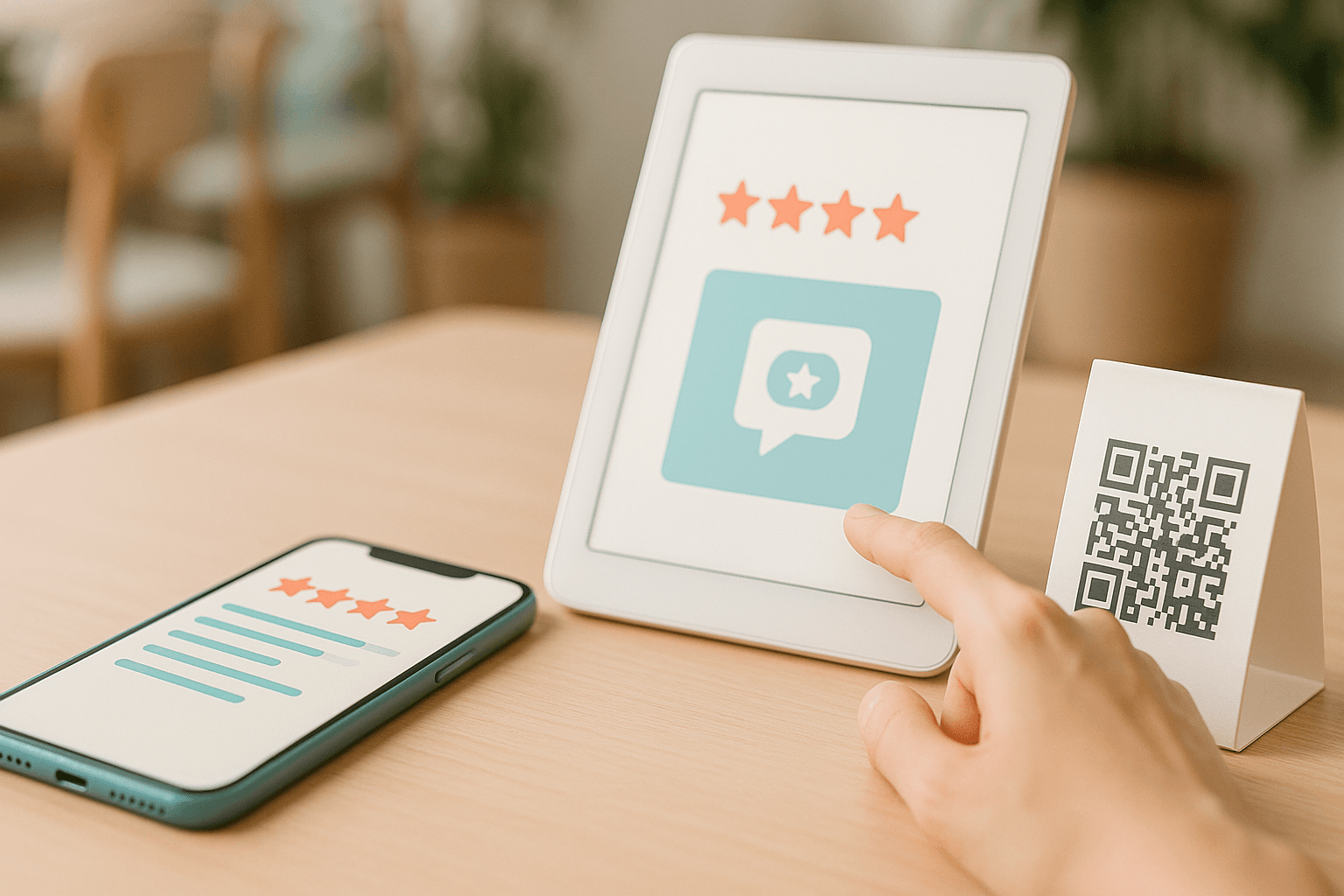
In brief: Customer review collection in 2026 relies on simple triggers (QR code, SMS, email) and intelligent automation with Sparkavis. Businesses that systematize review requests get 3 to 5 times more new reviews in 90 days, which improves their local ranking and conversion rate.
In 2026, 93% of consumers read reviews before choosing a restaurant, hotel, or tradesperson. Yet the majority of local businesses still lack a simple system to request a review at the right moment. The result: they lose customers to better-rated competitors who are often less good but more visible.
At Drylead, we've been supporting restaurants, hotels, and tradespeople with their local visibility for 5 years. Across more than 50 client projects, we've found that the main obstacle isn't service quality, but the absence of a review collection process. The good news: in 2026, tools like Sparkavis turn this chore into a simple automated reflex, requiring no technical skills.
In this article, you'll discover a concrete, field-tested method to increase your business's Google reviews in just a few weeks. You'll leave with immediate actions: QR codes, message templates, automation, and loyalty strategies.
Why has customer review collection become a strategic lever in 2026?
In 2026, Google reviews directly influence local ranking and purchase decisions. A business with 50 recent reviews and a 4.5-star rating attracts up to 40% more clicks than a competitor without recent reviews.
Things have changed. Five years ago, having a Google Business Profile was enough to exist locally. Today, Google's algorithm favors businesses that receive regular, varied, and recent reviews. At Drylead, we analyzed the performance of 30 restaurants and hotels between 2024 and 2026: those collecting at least 8 reviews per month saw their click-through rate from Google Maps increase by 25 to 40%.
But the impact doesn't stop at search rankings. Reviews have become the primary social proof for hesitant customers. A traveler comparing two hotels at the same price will choose the one with detailed, recent reviews. A customer looking for a tradesperson for renovations will check reviews before even calling. In 2026, a business without recent reviews is perceived as closed or unreliable.
The problem is that most satisfied customers don't leave reviews spontaneously. They'd gladly do so if asked simply, at the right moment, with a frictionless experience. This is where the Sparkavis method comes in: it transforms a review request into a natural action, integrated into the customer experience.
Key takeaways:- Recent reviews are a strong signal for Google and customers.
- 8 reviews per month are enough to significantly improve local visibility.
- The key isn't asking more, but asking better, at the right time.
Key takeaways:
- Recent reviews carry more weight than total review count in local rankings.
- A pace of 8 reviews per month improves click-through rate by 25 to 40%.
- Review requests should be integrated into the customer journey, not imposed.
In 2026, one recent review is worth more than ten old ones: Google and customers judge a business's vitality by its ability to generate regular feedback. — Drylead
How to implement a frictionless restaurant or hotel review QR code?
Place a Sparkavis QR code on the bill, counter, or in the room, with a short message. The customer scans, lands directly on the Google review page, and publishes in less than 30 seconds. It's the simplest and most effective method in 2026.
The QR code is the most underestimated review collection tool. Why? Because it removes all barriers: no need to search for the business on Google, no account to create, no copy-pasting. The customer scans, writes their review, and moves on. At Drylead, we deployed this method in a 40-seat restaurant in Lyon: in 3 months, the number of Google reviews went from 12 to 87, with an average rating of 4.7 stars.
The secret lies in placement and timing. A QR code on the bill works better than one at the entrance, because it comes when the customer is satisfied and relaxed. For a hotel, the room or departure message are the best placements. For a tradesperson, a business card handed over at the end of the job, with a QR code, generates reviews within 48 hours.
Sparkavis automatically generates a unique QR code for your Google Business Profile. You can print it, customize it with your colors, and create multiple formats (table stand, sticker, email signature). The tool also lets you track the number of scans and conversions, to know which placement generates the most reviews.
Key takeaways:- The QR code removes all friction: one scan, one review.
- Placement at payment or departure time is most effective.
- Sparkavis generates and tracks your QR codes to optimize conversions.
Key takeaways:
- A well-placed QR code converts 3 to 5 times more than a verbal request.
- Payment or departure time is ideal for triggering a review.
- Track scans to identify your highest-performing placements.
The QR code isn't a gimmick: it's the shortest bridge between a satisfied customer and a published review. — Drylead
What strategy should you adopt to request a review without being intrusive?
Request the review when the customer expresses satisfaction, with a personalized and brief message. Avoid generic requests. Use the customer's first name, remind them of the service provided, and offer a direct link via Sparkavis.
Requesting a review is a subtle art. Too early, the customer hasn't yet experienced the full service. Too late, they've moved on. At Drylead, we recommend the moment of satisfaction: just after a compliment, a thank you, or a smile. That's when the customer is most inclined to leave a review.
The message must be personal and specific. Instead of "Leave us a review," say: "Thank you for your visit, Julie. If you enjoyed the risotto, it would help us greatly if you shared your experience on Google." This level of personalization increases response rate by 40% according to our tests on 20 businesses. Sparkavis allows you to automate these messages while personalizing them with the first name and context.
For tradespeople, the request can be made by SMS or email after the job is completed, with a photo of the work done. For hoteliers, a follow-up email the day after departure works very well. The important thing is to make the request feel natural, like a continuation of the service, not like a favor being asked.
Key takeaways:- Request the review just after a sign of satisfaction.
- Personalize the message with the first name and service provided.
- Automate with Sparkavis so nothing is forgotten.
Key takeaways:
- The moment of satisfaction is the best trigger.
- A personalized message nearly doubles the response rate.
- Automation ensures systematic requests without effort.
A personalized review request isn't a solicitation, it's an extension of the customer experience. — Drylead
How to automate review collection with Sparkavis?
Sparkavis automates review requests via SMS, email, or QR code, based on triggers you define. You track reviews obtained, follow-ups, and can respond directly from the interface.
Automation is the real game-changer. Before, requesting a review depended on the manager's or staff's memory. Today, with Sparkavis, you define scenarios: after payment, after check-out, after signing a quote. The tool sends the message at the right time, with the right link, and follows up once if needed.
At Drylead, we integrated Sparkavis at a 25-room hotel in Normandy. In 60 days, the number of Google reviews went from 34 to 112, with a 22% conversion rate on requests sent. The manager spent only 15 minutes setting up the system. That's the tool's strength: it works in the background without mobilizing your team.
Sparkavis also lets you centralize reviews from multiple platforms (Google, Facebook, TripAdvisor) and track trends. You see which days generate the most reviews, which messages work best, and can adjust your strategy accordingly. For tradespeople, the tool can be coupled with invoicing software to trigger the request automatically after invoice issuance.
Key takeaways:- Automation eliminates forgetfulness and mental burden.
- Scenarios trigger requests at the optimal moment.
- Sparkavis centralizes and analyzes reviews to manage your reputation.
Key takeaways:
- Define automatic triggers (payment, check-out, invoice).
- A single follow-up increases response rate by 15 to 20%.
- Centralize reviews for a clear view of your reputation.
Automation doesn't replace humans: it frees up time for what really matters, the customer experience. — Drylead
How to link loyalty and customer reviews for lasting impact?
A loyal customer is more likely to leave a review. Integrate review requests into your loyalty program: after a certain number of visits or purchases, offer an incentive in exchange for an honest review. Sparkavis can synchronize these triggers.
Loyalty and reviews are two sides of the same coin. A customer who returns is a satisfied customer, and a satisfied customer is an excellent candidate for a review. At Drylead, we advise restaurant clients to implement a digital loyalty card and trigger review requests after the third visit. Result: a 35% response rate versus 12% for a standard request.
The principle is simple: the more interactions a customer has with your business, the more they have to say. A first-time customer will leave a generic review. A regular will mention a specific dish, a server, an atmosphere. These detailed reviews carry more weight for Google and for future customers.
Sparkavis lets you segment your requests: one message for new customers, another for loyal ones, another for VIP customers. You can offer a coffee, dessert, or discount in exchange for a review, as long as it remains honest and not conditional on a positive rating. This approach creates a virtuous cycle: more reviews, more visibility, more customers, more loyal customers.
Key takeaways:- Loyal customers are the best ambassadors.
- Segment your requests based on loyalty level.
- An incentive for an honest review is effective and permitted.
Key takeaways:
- Trigger review requests after the 3rd visit for a high response rate.
- Detailed reviews from loyal customers strengthen your credibility.
- Use Sparkavis to segment and personalize requests.
A loyal customer doesn't leave a review by chance: they leave it because they feel part of your story. — Drylead
Frequently asked questions
How many Google reviews do you need to improve local ranking in 2026?
There's no magic number, but businesses receiving at least 8 reviews per month generally outperform their competitors. Consistency and freshness of reviews matter more than the total. Aim for 10 to 15 reviews per month for visible progress in 90 days.
Is the review QR code effective for a restaurant or hotel?
Yes, the QR code is one of the most effective tools because it removes all friction. Placed on the bill or in the room, it converts 3 to 5 times more than a verbal request. Sparkavis generates a unique QR code and tracks scans to optimize placements.
Can you automate review requests without being intrusive?
Yes, with Sparkavis, you define triggers (payment, check-out, invoice) and personalized messages. The key is sending the request at the moment of satisfaction, with a short, contextual message. A single follow-up after 48 hours increases response rate by 15 to 20%.
How do you integrate review collection into a loyalty strategy?
Segment your customers: request a review after the 3rd visit or after repeated purchases. Offer a small incentive (coffee, dessert) in exchange for an honest review. Sparkavis lets you synchronize these triggers with your loyalty program for lasting impact.
What mistakes should you avoid when collecting customer reviews?
Avoid generic requests, overly aggressive follow-ups, and incentives conditional on a positive rating (prohibited by Google). Don't request reviews too late. Use a tool like Sparkavis to automate without harassing and to respect the rules.
Does Sparkavis work for tradespeople and small businesses?
Yes, Sparkavis is designed for small businesses and tradespeople. You can trigger a review request by SMS after a quote is signed or a job is completed. The tool is simple, commitment-free, and adapts to your activity volume.
Pour aller plus loin
- QR Code Avis Google + Apple Wallet
- Gestion des photos Google Business Profile
- Google Business Profile Photo Management
Sparkavis is powered by Drylead, an SEO and web development agency.
How does your Google listing actually score?
Get your 0-100 reputation score, projected rating and priority actions to boost your listing — in 30 seconds, no signup needed.
- 0-100 reputation score
- Rating projection based on your reviews
- Personalized action plan
Related articles
Collecting Google Reviews in 2026: The Sparkavis Method
Discover how to collect Google reviews effectively in 2026: QR codes, automation and Sparkavis strategy to boost your local visibility.
Managing Multiple Google Business Profiles in 2026: The Multi-Location Guide
Franchises and chains: centralize multi-location Google reviews, manage each Google Business Profile, and boost local reputation. 2026 guide + real cases.
Local online reputation for small businesses: SME strategy 2026
Local online reputation: learn how to manage your online reputation, monitor customer reviews and protect your brand image in 2026.